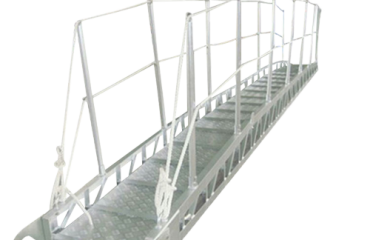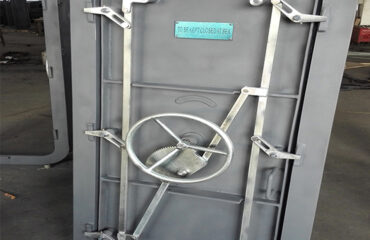


One keeps water out, and the other keeps fire back, but at first glance they look almost the same. This question comes up a lot during refit planning: can a watertight ship door simply be pressed into fire service? The short answer is no, and the longer answer explains why the two jobs pull against each other in design. A door that must stay sealed against flooding and a door that must stay intact against flame are solved problems in different ways, and mixing them up can create a genuine safety gap on board.
Why The Two Purposes Are Not Interchangeable
What A Watertight Door Actually Promises
A watertight door exists to stop seawater from spreading between compartments during flooding. Its sealing performance depends on a soft gasket around the frame, multiple dogs or wedges pulling the leaf tight, and a frame machined flat enough for even compression. When the ship lists or a tank floods, water pressure pushes against the leaf, and the gasket must close every tiny gap. The whole design philosophy here is flexible: a compliant seal that deforms under pressure and stays shut.
That soft gasket behaves very differently when heat arrives. Ordinary rubber and composition seals used for water protection soften, melt, or turn brittle once temperatures climb past a few hundred degrees Celsius. The sealing surface that works so well against cold water offers little resistance to a flame plume. So a door rated for water pressure has never been tested for fire exposure, and its components were never chosen for heat.
What A Fire Door Promises Instead
A marine fire door protects escape routes and division spaces by holding back flame and hot gases for a measured period. Its job is to keep the opening from becoming a chimney. The leaf core usually carries an insulating material, the facing steel sheet resists deformation, and the seal around the perimeter is intumescent: it swells when heated and blocks gaps that open as metal expands. Many fire doors also include automatic self-closing hardware and hold-back magnets linked to the fire detection system.
Notice what is missing from that list. There is no claim that the door will hold water under hydrostatic pressure. The intumescent seal sits in a groove and relies on heat to activate; in its cold state it does not deliver the continuous compression a watertight gasket gives. Build strength for fire and sealing strength for water come from different parts of the assembly, and you cannot bolt both requirements onto one leaf without extra engineering.
Reference Parameter Table: Watertight Door Versus Fire Door
| Feature | Watertight Ship Door | Marine Fire Door |
|---|---|---|
| Primary purpose | Prevent flooding between compartments | Contain flame and hot gases |
| Seal type | Soft rubber / composition gasket | Intumescent fire seal |
| Closing method | Manual or power-operated dogs | Self-closing, often magnetic hold-back |
| Test focus | Hydrostatic pressure, leakage over time | Fire endurance, integrity, insulation |
| Typical rating | Hydrostatic head per local regulation | A-60, A-30, B-15, B-0 classes |
| Core material | Solid or stiffened steel plate | Steel facing over insulation core |
| Heat resistance | Not evaluated | Tested per fire endurance procedure |
| Common location | Watertight bulkheads, tank boundaries | Corridors, stairways, accommodation divisions |
The table makes the split easy to see. The steel skin may look similar, but the gasket, core, hardware and test regime each follow a different rulebook.
The Engineering Reason One Leaf Cannot Cover Both Ratings
There are custom assemblies where a door carries both a watertight certification and a fire rating, and they do exist on selected bulkheads near accommodation spaces. These are purpose-built units: heavier leaves, dual seal arrangements, and separate test evidence for each condition. They are not the result of reusing a standard watertight ship door and adding fire paint or ceramic strip on site.
When a manufacturer certifies a door, each rating stands on its own test report. A fire endurance test exposes the assembled door, frame, hardware and seals to a furnace for the rated time and checks that flame does not pass through and that the unexposed side stays below a temperature limit. A watertight test pressurizes the closed assembly with water and watches for seepage along the gasket line. Passing one gives no credit toward the other. Surveyors inspect the certification plate and the test documentation separately, and a door presented under the wrong rating will be rejected at inspection.
Practical installation matters too. A watertight door sits in a frame welded into a watertight bulkhead, and its dog pattern is tuned to that frame. A fire door needs clearances for intumescent expansion and hardware that releases on alarm. Retrofitting fire seals onto an existing watertight leaf changes the compression the original gasket was designed for, which can quietly destroy the water rating you were trying to keep.
Frequently Asked Questions
Can A Watertight Ship Door Be Used As A Fire Door In An Emergency?
No. In an emergency it may physically close, but it has not been tested or certified for fire endurance. Its gasket and core will fail under heat, and relying on it as a barrier gives a false sense of protection. Fire-rated divisions must use doors that carry the matching class mark.
Why Does A Watertight Gasket Fail When Exposed To Fire?
The soft sealing compounds chosen for water resistance are organic rubber blends. They are formulated to stay flexible in cold seawater, not to survive furnace temperatures. Under heat they decompose, lose compression, and leave gaps through which hot gases pass. Fire seals solve the problem by swelling rather than staying soft.
What Fire Ratings Apply To Marine Ship Doors?
Common classes follow the fire division system used in SOLAS and the FTP Code: A-60 means 60 minutes of integrity and insulation, A-30 gives 30 minutes, B-15 gives 15 minutes for B-class divisions, and B-0 offers integrity only. The required class depends on the space and the deck below, so it should be confirmed against the vessel’s safety plan before ordering.
Do Some Ship Doors Carry Both Certifications At Once?
Yes, but only as specially engineered dual-rated assemblies with separate test reports for water pressure and fire endurance. Standard watertight units are not dual-rated, and a supplier’s claim of “fire resistant” without a fire test report does not replace certification.
How Are Marine Fire Doors Tested Before Delivery?
The assembly is mounted on a test rig and exposed to a controlled furnace curve for the rated duration. Inspectors measure flame passage through joints, surface temperatures on the cool side, and deformation of the leaf. Hardware such as closers and hold-back magnets are tested alongside the leaf, because a door that will not close on its own fails the installation even if the leaf survives.