

Have you ever stood on a pier and looked up at the windows on a cargo ship or a ferry? From thirty metres away they look like plain glass in a metal frame. That is what most people assume, and it is only half the story. A pane that has to survive salt spray, green seas, hammering sun and twenty years of engine vibration is a completely different animal from the one in your living room. So let us answer the question that keeps coming up in buyer emails: what are these panes actually made of?
The Short Answer: Four Layers, Four Material Families
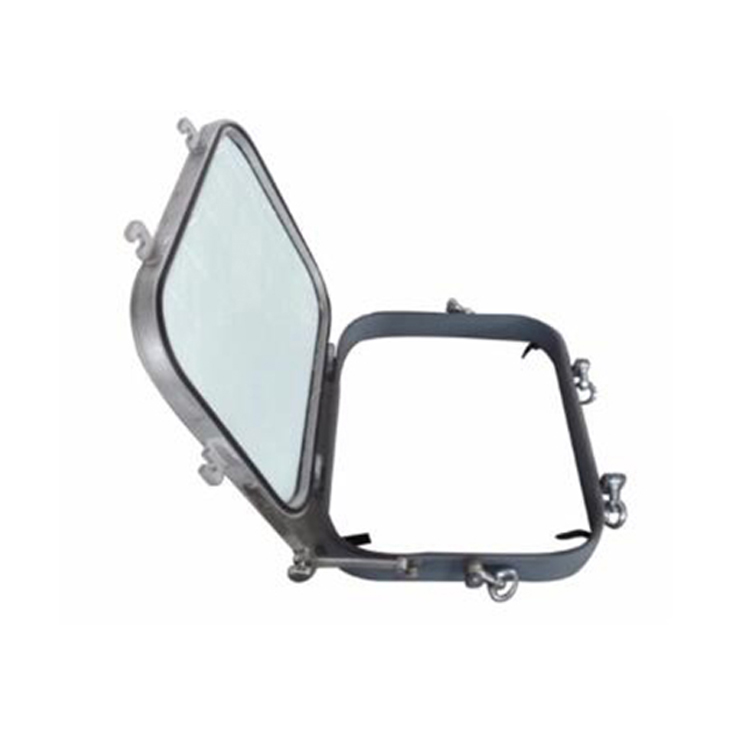
An assembly on board is a sandwich. There is the transparent pane, the frame that carries it, the gasket that seals the edge, and the compound that bonds the whole thing into one pressure-resistant block. Each layer has its own material family, and each one can be swapped — but not independently. Change one and you change the weight, the price, the fire rating and, sometimes, whether the unit still passes its type approval.
For standard commercial tonnage the pane is tempered glass, laminated glass, polycarbonate or cast acrylic. The frame is marine aluminium or 316L stainless steel, occasionally bronze on older hulls. The seal is EPDM, neoprene or silicone. Keep those four families in mind and the rest of this article is much easier to follow. The honest truth is that a ship window is only as good as its weakest layer, and the weakest layer is almost never the glass.
Glass: Tempered, Laminated, and Sometimes Heated
Why tempered glass wins most of the time
Tempered glass starts as ordinary float glass and gets heated to roughly 620–700 °C, then quenched in air. The surface goes into compression and the core stays in tension, which lifts the bending strength to four or five times that of annealed glass. The real advantage at sea is the break pattern: it fails into small, blunt, roughly cubic fragments instead of long blades. On a vessel where crew walk past the pane in heavy rolling, that difference matters a great deal. Typical thicknesses run from 6 mm in small accommodation windows up to 15–19 mm for large wheelhouse panes, and the edges are ground and usually polished so no micro-crack can start there.
When laminated glass makes more sense
Laminated glass is two or more panes bonded with a PVB or ionoplast interlayer, usually 1.52 mm thick per layer. If something hits it, the pane cracks but the interlayer holds the pieces in the frame — which is exactly what you want above a wheelhouse or in a window facing a walkway. It also gives you a place to hide a heating element or a tinted film. Some specifications call for a laminated outer pane with a tempered inner pane, which combines impact retention with a clean break at the inner face.
Heated glass for cold routes
On Baltic, Arctic and Great Lakes runs, the wheelhouse pane often carries a transparent metal-oxide heating film or a fine wire grid, drawing 12 to 24 V and clearing ice in a few minutes. I have watched a 24 V film go from frosted to clear in under four minutes at −25 °C ambient, and that is the kind of detail that decides whether a master keeps the window or asks for a replacement.
Transparent Plastics: Polycarbonate and Cast Acrylic
Polycarbonate — the impact champion
Polycarbonate is the material people reach for when weight and impact are the two hard constraints. It weighs roughly half of glass at equal thickness and will absorb hits that would destroy a tempered pane. It shows up on ice-class workboats, on bridge wing windows that catch boarding seas, on offshore crew transfer vessels and on any unit where the owner wants a single heavy pane rather than a laminated stack. Its weaknesses are real: it scratches, it yellows under UV unless it has a proper hard coat, and its thermal expansion is roughly seven times that of glass, so the frame design has to allow for movement.
Cast acrylic — clear but brittle
Cast acrylic, PMMA, is optically cleaner than polycarbonate and cheaper, and it machines beautifully for curved or shaped panes on yachts and passenger vessels. What it does not do is take impact. Under a wave slam it can craze or shatter, so it belongs in protected positions, interior screens and shaped superstructure glazing far from the spray zone.
Frames: Marine Aluminium versus 316L Stainless Steel
Aluminium 6061-T6 and 5083
Most production units use an extruded 6061-T6 profile or 5083 / 5086 plate for the frame, anodised to 15–25 µm or painted with a marine system. It is light, it machines fast, and in the splash zone it performs well as long as it never sits in permanent contact with bare steel or with untreated stainless in a wet pocket. Isolate the two metals properly and the frame will outlast the glass.
316L stainless steel
Where loads are high, where welds have to be watertight, or where the unit sits in the ice belt and takes grinding contact, 316L is the safer choice. It costs more, it is heavier, and it needs a decent passivation after welding, but it holds up where aluminium starts to look tired. On ice-class hulls the frames and the dogs are frequently stainless for exactly this reason.
Gaskets, Sealants and Bedding Tape
The seal is where most leaks are born, not in the pane. EPDM and neoprene gaskets at 60–70 Shore A handle the compression cycling without taking a permanent set. Silicone is chosen where temperature swings are wide; polysulfide where adhesion to painted steel matters most. Glass should never be bedded directly against metal — a bedding tape or a butyl strip between them prevents point loading and fretting. A watertight unit normally adds mechanical dogs or a bolted flange on top of the gasket, while a weathertight unit relies on the gasket and sealant alone. That single distinction explains most of the price difference between two visually identical windows.
Typical Specifications at a Glance
Table 1 — Typical material specs for a ship window assembly
| Layer | Common material | Typical specification | Where it is used |
|---|---|---|---|
| Pane | Tempered glass | 6–19 mm, edge ground, strength 4–5× annealed | Wheelhouse, superstructure, accommodation |
| Pane | Laminated glass | 6+6 mm with 1.52 mm PVB / ionoplast | Bridge front, walkway-facing, heated units |
| Pane | Polycarbonate | 8–15 mm, hard-coated, UV stabilised | Ice belt, bow, bridge wings, workboats |
| Pane | Cast acrylic | 6–20 mm, shaped or curved | Yachts, interior screens, shaped superstructure |
| Frame | Aluminium 6061-T6 / 5083 | Anodised 15–25 µm or marine paint | Standard commercial units |
| Frame | 316L stainless steel | Welded, passivated, Ra ≤ 3 µm | Ice class, high-load, hull openings |
| Seal | EPDM / neoprene | 60–70 Shore A, −40 to +90 °C | Most gasketed units |
| Seal | Silicone / polysulfide | Neutral cure, ±25% movement | Wide temperature swing, painted steel |
| Fixing | Mechanical dogs / bolted flange | Sized to design head plus safety factor | Watertight openings |
Matching the Material to the Window’s Position
Bridge front and wheelhouse
Here the priority is optical quality plus ice clearing. Laminated glass with a heating film, or a tempered outer pane, usually wins; polycarbonate only where the owner accepts the scratch trade-off in exchange for impact margin.
Superstructure side windows
Tempered glass in an aluminium frame handles this duty well and is the cheapest reliable answer. If the window faces a mooring deck or a crane swing zone, step up to laminated.
Watertight openings in the hull and deckhouse
These are pressure boundaries, so the pane is thicker, the frame is heavier and the seal is backed by dogs. Stainless frames with laminated or thick tempered panes are the normal specification.
Ice belt and bow region
This is where which ship window material you pick changes the maintenance bill more than the purchase price. Polycarbonate with a hard coat, or a very heavily built laminated unit, keeps the pane intact when ice and slush grind past it.
What Tests and Certificates Back the Material Up
Type approval from a classification society is the paper that matters, and it is granted against a test programme rather than a datasheet. Expect hydrostatic pressure testing beyond the design head, hose testing on the seal, thermal cycling between cold and tropical extremes, salt spray exposure, adhesion pull tests on the sealant and an impact test on the pane. Ask for the certificate number and the test report, not just a spec sheet with a temperature range printed on it. If a maker cannot show both, the material claim is only a claim.
FAQ
Tempered or laminated — which one do yards actually order?
Most newbuild orders are tempered glass for side and accommodation windows, and laminated glass for bridge front units where heating films or impact retention are required. Laminated is also the safer retrofit when the original opening was designed for a heavier build.
Can plastic replace glass if weight is a problem?
Yes, in the right position. Polycarbonate saves roughly half the weight and takes far more impact, but it needs a hard coat and it will not match glass for optical clarity over fifteen years. Acrylic is not a substitute in any spray-exposed position.
What is the frame usually made from?
Aluminium 6061-T6 or 5083 for standard commercial tonnage, and 316L stainless steel for ice class, high-load or welded hull openings. Bronze and steel frames still turn up on older vessels.
How thick is the glass?
Small accommodation windows typically run 6–8 mm tempered. Wheelhouse and superstructure panes run 10–15 mm, and large bridge fronts or pressure boundaries go to 19 mm or a laminated stack. Thickness follows the design head, the pane size and the class rule, not a catalogue default.