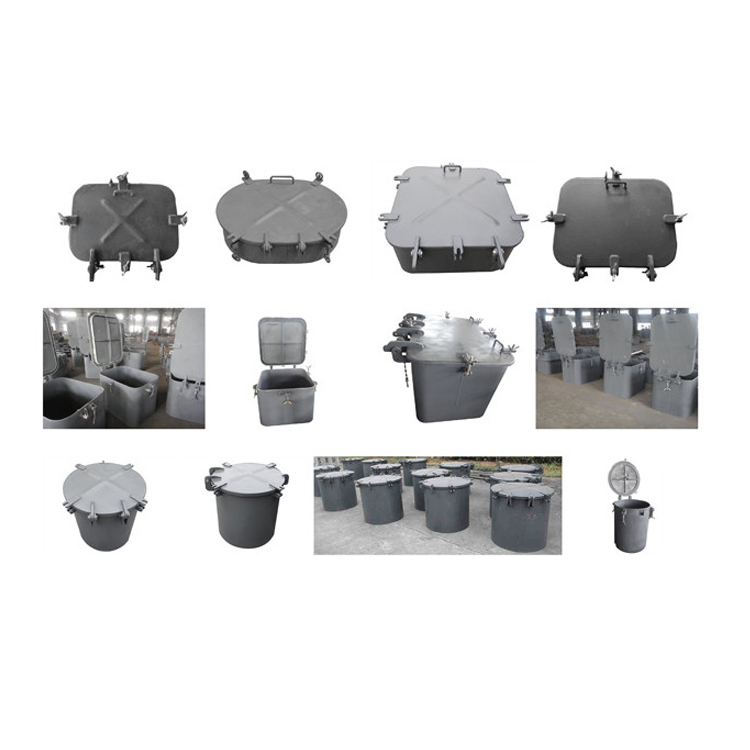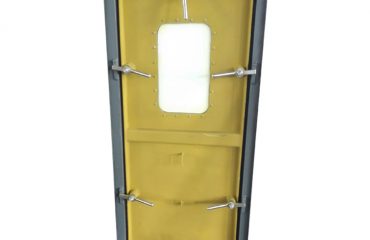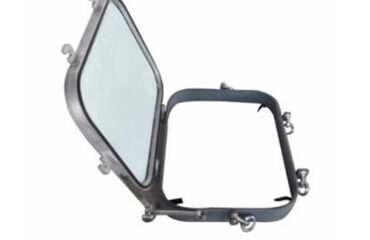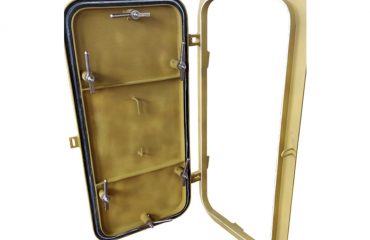


A common mistake is treating every hatch or manhole opening the same. A cover on a cockpit sole that gets walked across daily has a completely different job from a tank access cover that is opened twice a season and otherwise ignored. The first needs stiffness and slip resistance; the second prioritizes sealing integrity and corrosion resistance on the mating surfaces.
Classification rules reflect that distinction. Hatch covers designed to be walked on generally need to withstand at least 4.5 kN/m², with a point-load minimum around 0.9 kN. Covers that are not meant for foot traffic must be clearly marked so nobody treats them as a step. That single distinction already narrows the field before you even get to material choice.
Aluminum vs. Steel vs. Composite: What 2026 Actually Looks Like
Aluminum has become the default for weight-sensitive builds. Marine-grade grades such as 5083 and 6061 are common because they offer a strong strength-to-weight ratio and hold up well in salt air. On smaller craft, yachts, and offshore platforms where every kilogram affects performance or stability, an aluminum marine cover is often the sensible starting point. The trade-off is that aluminum is softer than steel, so the sealing surface and hinge points need careful design to avoid galling or deformation over years of use.
Steel remains the workhorse for commercial tonnage. Shipbuilding steels like AH32 and DH36 appear on larger vessels where load-bearing capacity and resistance to impact matter more than saving weight. A properly coated steel cover—typically with an epoxy or polyurethane system—handles heavy deck cargo and repeated mechanical stress without the flex you might see in a lighter alloy. The downside is maintenance: once the coating is compromised, rust moves fast in a salt-laden environment.
Composite and fiber-reinforced covers are the quiet disruptor. Industry projections for 2026 point toward high-strength aluminum and fiber-reinforced composites taking more share because they reduce weight without sacrificing pressure resistance. For a recreational boat owner, a composite marine cover can be attractive if the opening is not in a high-traffic load path and the priority is minimizing corrosion maintenance. The caveat is that composite behavior under concentrated point loads is less forgiving than metal, so the supporting coaming needs to be stiff.

Key Specifications Worth Checking Before You Buy
The table below consolidates parameters that come up repeatedly in technical documentation and class-society-oriented product data. Use it as a filter, not a shopping list—your installer or surveyor should confirm final suitability for your specific vessel and location.
| Parameter | Typical Range / Options | Why It Matters |
|---|---|---|
| Material | Aluminum alloy (5083, 6061), carbon steel (Q235, AH32/DH36), stainless steel (304/316), composite | Determines weight, corrosion path, and repairability |
| Clear opening | DN350–DN600 common; custom sizes available | Must match tank or void access requirement |
| Cover plate thickness | ~6 mm for openings under 600 mm; ≥10 mm for openings over 1000 mm | Directly affects stiffness and deflection under load |
| Pressure rating | Up to 0.6 MPa for many standard non-pressurized to medium-pressure covers | Ensures seal integrity under head or tank pressure |
| Gasket material | NBR (−30 °C to +100 °C typical); EPDM (−40 °C to +120 °C typical); Viton for aggressive media | Wrong elastomer leads to hardening, swelling, or leakage |
| Walk-on load | ≥ 4.5 kN/m² (point load not less than 0.9 kN) | Safety and structural confidence in traffic areas |
| Compliance reference | ISO 12216 (small craft hatches), ISO 15497, class rules (CCS, ABS, DNV, LR) | Signals the cover has been evaluated against recognized strength and watertightness criteria |
The gasket temperature ranges above are not marketing numbers—they come from elastomer service limits. NBR is fine for most fuel and oil exposure but stiffens in cold; EPDM handles wider temperature swings and weathering better but is not the first choice for petroleum-based media. If the cover sits near an engine space or a tank carrying hot fluids, the gasket choice can matter as much as the cover plate material.
The 2026 Trend: Lighter, Smarter, But Still Seal-First
The direction of travel is clear. Lightweighting is no longer a niche request—high-strength aluminum and composites are being pushed harder to reduce top-hamper weight without dropping pressure capability. Coatings are also improving: self-lubricating or low-friction surface treatments are extending maintenance intervals on locking mechanisms and sealing surfaces.
There is also movement toward sensor integration and quicker locking. Hydraulic or electric quick-action mechanisms are being discussed for openings that need remote or single-person operation, and integrated pressure or gas sensors are positioned as a way to flag confined-space conditions before someone opens a cover. For most recreational boat owners in 2026, those features are not yet standard, but they are worth knowing about because they influence how much space and wiring you may want to leave around a hatch opening during a refit.
What has not changed is the sealing principle. A marine cover that does not keep water and vapor where they belong is not improved by a lighter alloy or a clever latch. The gasket land, the coaming flatness, and the locking pressure distribution still do the real work.
FAQ
Can I replace a steel cover with aluminum on the same coaming?
Sometimes, but the coaming and hinge geometry need checking. Aluminum covers are often thinner or differently stiffened, and the mating surface may need a compatible isolator to prevent galvanic interaction between dissimilar metals. Do not assume bolt-hole patterns and sealing land widths carry over without measuring.
How do I know if my cover needs a walk-on rating?
If the cover is in a deck, cockpit sole, or any surface where a person could reasonably step, treat it as a walk-on application. The recognized benchmark is 4.5 kN/m² plus a point-load check. Covers not intended for foot traffic should be marked accordingly so crew do not create an unintended load case.
Does a higher pressure rating always mean a better seal?
Not automatically. The rating indicates what the assembly is designed to withstand, but the gasket compression and surface finish at the sealing land determine whether that rating is realized in service. A high-rated cover installed on a pitted or distorted coaming can leak sooner than a lower-rated cover on a clean, flat seat.
Is composite a realistic alternative to metal for a tank access cover?
It can be, provided the cover is not in a high-point-load path and the supporting structure prevents local flexing. Composites bring corrosion resistance and weight savings, but they behave differently under concentrated loads and impact. For low-traffic tank access in a weight-sensitive boat, they are worth discussing with a surveyor or builder.